
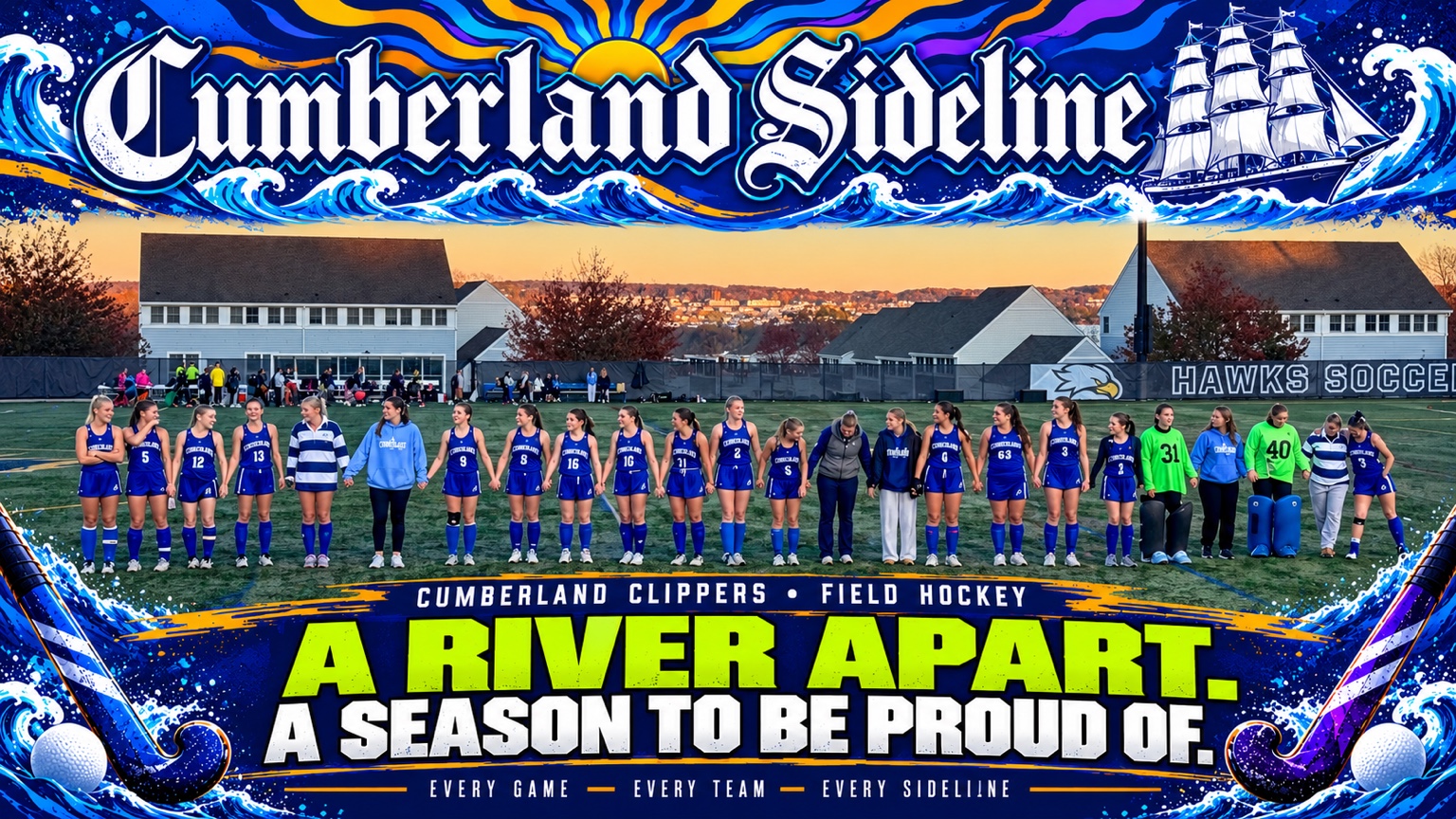
Long before there were Clippers and Lions, there were settlements along the Blackstone. European settlement in what became Cumberland dates to 1635. Not too long thereafter, Lincoln was said to be established around 1650. These neighbors have had a few hundred years to get acquainted.
And for all the pride we take in our own side, there is plenty that looks familiar across the river. Hardworking families. Community ties. Generations of kids growing up with a town behind them and a little extra incentive when Lincoln or Cumberland appears on the schedule.
Sometimes, the biggest difference feels like the river running between them.
When Cumberland and Lincoln met for the first time on September 24, even their records matched: 5–2. They spent the night challenging passes, contesting possession and making each other earn a way through. At the end of it, they were still together. One goal apiece. A 1–1 tie.
Only one game apiece stood between the first meeting and the rematch, and even that brought a shared setback. On September 28, Cumberland fell 3–2 in overtime to Lincoln School of Providence, while Lincoln lost 2–1 to South Kingstown. Different opponents. The same one-goal disappointment.
Three days later, they were back across from one another at Tucker Field, carrying matching 5–3–1 records into another meeting with their neighbors. Each had a loss to answer. Neither had found a way past the other.
This time, Cumberland had to climb out of a two-goal hole. Delaney Eckman scored off a setup from senior captain Payton Jolicoeur, and Jolicoeur converted the penalty stroke that brought the Clippers even.
Both teams found more offense in the rematch. Neither found separation. The 2–2 tie left both at 5–3–2, still moving through the fall almost step for step.
Those were the kinds of games that sharpened both teams for the stretch run. Long before the playoffs arrived, Cumberland and Lincoln were already competing in that atmosphere, learning to answer pressure and keep working for the next opening. They carried that experience through the wins and setbacks that followed.
By the October 19 regular-season finale, both teams were battle-tested, and their records matched again at 7–5–2. They came in again all knotted up. The river was still doing most of the separating.
This time, Cumberland broke through.
The Clippers built a 4–0 halftime lead and won 6–2, with Maddison Skurka, Jolicoeur, Tessa Nicastro and Madelyn Crawford all scoring. When Lincoln pushed back, Cumberland responded. The attack had contributions coming from different places, and the chances were becoming finishes.
Cumberland had finally put some distance between the neighbors. Those three regular-season meetings had sharpened both teams, giving them experience under playoff pressure before the postseason even began. When the championship arrived, they would face a familiar test.
On Sunday, one goal separated them on the field.
Lincoln earned a 1–0 victory over Cumberland in the Division II championship at Roger Williams University, bringing the Clippers’ third consecutive trip to the final to a difficult close. The result belonged to the Lions, but there was little daylight between them. This was a game either team could have won.
For much of the first half, Cumberland carried the play. The Clippers were strong in the physical contests, won balls back and connected passes through midfield into the attacking end. They spent sustained stretches working around Lincoln’s circle, putting themselves in the positions where a touch, a rebound or a clean finish could make the difference.
Lincoln brought plenty of physical play of its own. Cumberland had the better of the early pressure, but the Lions made the final opening difficult to find. Their defense held through those stretches, and the teams reached halftime at 0–0.
Tessa Nicastro was a steady presence on both sides of the ball, carrying possession forward and working just as hard when Cumberland needed to defend. Her afternoon ended later in the game after she took a shot to the leg. Before being forced out, the junior had given the Clippers strong, consistent play in both directions.
Senior captain Payton Jolicoeur was heavily involved, strong on the ball and persistent in helping Cumberland keep its attack moving. Delaney Eckman and Tatum Connors were also among the players repeatedly involved as the Clippers worked for an opening. Around the cage, Maddison Skurka put herself in position for scoring opportunities. The work was there. So were the chances. The finish proved harder to find.
Cumberland continued to compete strongly after halftime, while Lincoln grew into the game and brought more pressure of its own. It was a familiar shift from the first 1–1 meeting: the Lions remained difficult to put away and became more threatening as the game developed.
With much of the early play at the other end, Emma Maccio had less to handle in the opening quarter. As Lincoln’s opportunities increased, she answered with strong work in net, finishing with six saves. The freshman and the defense kept Cumberland within one goal and in position to answer. In a final with so little room for error, that effort deserves its share of the credit.
The breakthrough came with 12:55 remaining in the fourth quarter. On a Lincoln penalty corner, Izzy Marano sent a shot toward the cage from the right. The rebound stayed within reach of Maddie Desmarais, who put it away to give the Lions a 1–0 lead.
Cumberland still worked its way into a chance to draw even. Midway through the quarter, Eckman advanced down the right wing and found Skurka inside with only goalkeeper Emmy Araujo in front of her. Araujo came out to narrow the opening, and Skurka’s attempt struck her pads and deflected away. Cumberland had connected the pass and created the opportunity. Lincoln’s goalkeeper supplied the answer.
Araujo finished with five saves, and the Lions protected their lead to secure a third championship in four years. Cumberland could not find the equalizer, despite the pressure and the opportunities it had created. That is a hard way to end a season, especially for a group that had worked its way back to this stage and stayed so firmly in the contest.
They gave their town a season worth following, right to the last game.
Head coach Delaney Cavanaugh deserves her share of the credit for how this team arrived at that stage: prepared, focused and ready to play good field hockey. The pressure on the ball, the persistence around the cage and the willingness to keep working when the finish would not come reflected a group committed to the task in front of it. Cavanaugh helped keep these girls moving toward a shared goal through the demands of a long season. Thank you, Coach, for the work behind that preparation and for helping give these players the opportunity to compete at such a high level.
Across the season, this group had shown plenty about who it was.
There were the tight shutout wins, with Emma Maccio and the defense helping make a single goal stand. There was the response after a difficult night against Barrington, when Cumberland came back with a 3–1 win over Pilgrim. There were overtime disappointments and another opportunity to get back to work.
Then there was the semifinal against Lincoln School of Providence. Annie Collins scored twice, including the double-overtime winner in a 3–2 victory over the defending champion. Cumberland had earned another place in the final by finding a finish in exactly the kind of close game that had tested it throughout the year.
Three straight championship appearances take sustained work. Seniors Annie Collins, Samantha Dressler, Delaney Eckman, Payton Jolicoeur and Maddison Skurka helped carry that work forward. Together, Cavanaugh’s coaching and their leadership laid the tracks for the program’s future success.
For those seniors, Sunday was the last time playing field hockey for Cumberland alongside this group. That deserves a moment of its own. They helped bring this program back to the championship stage and gave the younger players a season’s worth of examples: how to recover from a setback, how to stay involved in a tight game, and how to keep competing when the next goal is proving hard to find.
They leave with our thanks, and with every reason to be proud of what they contributed.
There is reason to look ahead, too. Eight juniors are eligible to return, along with younger players who have been part of this run. Another strong season will have to be earned, but Cumberland has an experienced group with the opportunity to build on what these seniors helped establish. They know how demanding the road can be. They have also seen where it can lead.
These programs will keep testing each other, building new chapters with the same edge. And just as the Blackstone keeps moving, so will this rivalry.